 ← Back to Blog
Computer Vision for Business: From Camera Feeds to Decisions
How modern computer vision turns cameras into an operations layer for quality, safety, retail, and logistics, plus the pipeline Compile Vision builds from capture to action.
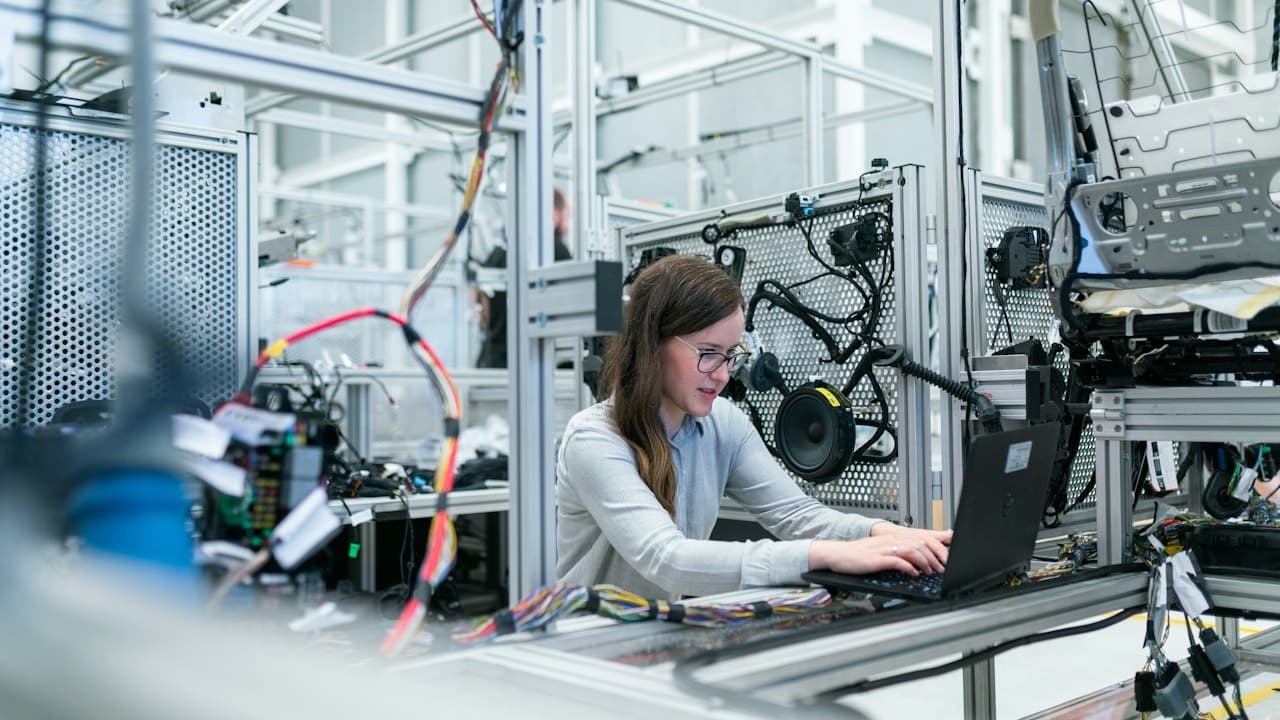
Computer vision connects cameras on the floor to decisions in your software stack.
Listen to this briefing
Speech is not supported in this browser. Try Chrome or Edge.
Most companies already have cameras. Few treat them as a product surface. The gap between a live feed and a reliable alert, ticket, or dashboard is where actually lives.
Models can detect defects, missing PPE, empty shelves, queue length, and package orientation. The hard part is the system around the model: capture quality, event rules, human review, and hooks into ERP, WMS, or Slack.
This briefing walks the visual story: why raw monitoring fails, what an insight layer looks like, how to design the pipeline, and how Compile Vision ships vision products that ops teams trust.
Raw feeds do not scale
Walls of monitors depend on tired eyes. Night shifts miss edge cases. There is rarely a structured event log, only footage someone might scrub after an incident.
That pattern is expensive and brittle. As camera counts grow, human-only monitoring collapses. You need detection that writes events, not more screens.
From detection to action
Production vision systems turn bounding boxes into business objects: a defect code, a safety incident, a restock signal, a line-stop recommendation.
Confidence thresholds, cooldown windows, and human-in-the-loop review keep false positives from training people to ignore alerts. Compile Vision designs that control plane with your ops rules.
What a business vision stack actually includes
Start with the job: inspect, protect, count, or guide. Choose cameras and lighting for that job, not generic CCTV alone. Stream or batch frames into a detector or multimodal model, then apply site-specific rules.
Persist events with images, timestamps, and camera IDs. Route high-severity items to humans. Sync accepted outcomes into the systems people already open every morning.
Eval matters as much as demos. Track precision/recall on your own footage, measure alert fatigue, and budget for model refresh when lines or packaging change.
Where Compile Vision fits
We build the software layer: ingestion, model integration, review UIs, alert routing, and analytics. Hardware partners own cameras and mounts; we make the vision loop useful inside your product or ops stack.
If you already have multimodal document AI or agents, vision events become another tool those systems can call, closing the loop from see → decide → act.
Key takeaways
Cameras without an event pipeline are storage, not intelligence.
Business value appears when detections become tickets, metrics, and actions.
Guard alert quality with thresholds, cooldowns, and human review.
Eval on your own footage before you scale camera count.
Compile Vision ships the product layer around vision models.
Vision product shapes (and how they differ)
Not every camera project is the same product. Pick the shape that matches your floor and your KPI.
| Approach | How it works | Best for | Differs by |
|---|---|---|---|
| Quality inspection | Fixed cameras watch a line; models flag defects or measure tolerances; rejects or rework tickets fire. | Manufacturing, packaging, electronics assembly. | Tight lighting and known SKUs; high precision required. |
| Safety & PPE | Detect missing gear, restricted zones, or falls; alert supervisors with evidence frames. | Warehouses, construction, plant floors. | False positives are costly, human review gates matter. |
| Retail / shelf ops | Spot out-of-stocks, planogram drift, and queue length; push tasks to store apps. | Grocery and big-box retail. | Messy scenes; needs strong ops workflow integration. |
| Logistics vision | Read labels, check orientation, count parcels; sync with WMS events. | DC sortation and last-mile hubs. | Speed and barcode/OCR fusion dominate. |
Tools & stack options
Practical pieces teams use to prototype and ship.
| Tool | Role |
|---|---|
| YOLO / RF-DETR / custom detectors | Real-time object detection on line or edge GPUs |
| OpenCV + camera SDKs | Capture, undistort, and preprocess frames |
| NVIDIA DeepStream / Triton | Multi-stream inference and model serving |
| Roboflow / CVAT | Labeling and dataset iteration |
| Multimodal LLMs (GPT-4o, Gemini) | Scene description and rare-event triage |
| Next.js review console (Compile Vision) | Human-in-the-loop queues and audit trails |
| Slack / ServiceNow / ERP APIs | Turn detections into tickets and actions |
| Prometheus + event store | Alert volume, precision, and latency metrics |
What you can build
- Defect detection with photo evidence attached to MES tickets
- PPE compliance heatmaps by zone and shift
- Shelf-gap alerts that create restock tasks in store apps
- Parcel orientation checks before auto-labeling
- Vision events as tools for warehouse AI agents
- Executive dashboards for escaped defects and response time
Architecture & diagrams
Computer vision to action pipeline
How frames become business events your teams can trust.
Where quality usually breaks
Fix capture and workflow before blaming the model.
Essential reading
References & further reading
Sources matter as much as the briefing itself. Start with the primary reference, then dig into the supporting links.
Practical detection baselines for industrial pilots.
- 2OpenCV documentation
Capture and classical vision preprocessing.
- 3NVIDIA DeepStream
Multi-camera streaming inference patterns.
- 4Compile Vision: Multimodal LLMs for business
When to mix detectors with multimodal reasoning.
Learning / build steps
- 1
Define the job
Inspect, safety, retail, or logistics outcome
- 2
Instrument capture
Cameras, angles, lighting, retention
- 3
Detect + rule
Model scores meet site policies
- 4
Review + route
Humans for edge cases; systems for the rest
- 5
Measure + refresh
Fatigue, precision, and model updates
Need computer vision wired into your operations?
Compile Vision designs and ships vision pipelines from camera ingest to alerts, review UIs, and system sync. Tell us the floor problem and we will map a delivery plan.
Contact Compile VisionRead next
Continue with related Compile Vision research briefings and builder guides.

13 min read
Multimodal LLMs for Business: Read PDFs, Images, and Screenshots
A builder briefing on multimodal LLMs and vision-language models: how they read PDFs, images, and screenshots, architecture patterns, evals, tools, and how Compile Vision ships document AI for real products.

13 min read
Intelligent Document Processing: Multimodal OCR to Your CRM
Intelligent Document Processing (IDP) with multimodal OCR: extract fields from invoices and forms, validate them, and sync to CRM or ERP. Architecture, tools, and Compile Vision delivery patterns.

14 min read
AI Agents Explained: From Chatbots to Autonomous Workflows
A newspaper-style briefing on AI agents in 2026: agent types compared (ReAct, tool-calling, multi-agent, swarm, voice, coding), tools, build paths, and how Compile Vision can ship one for you.