 ← Back to Blog
AI Guardrails for Production: Keep LLMs Safe, On-Brand, and Compliant
How to ship LLM features without open-ended risk: input/output filters, policy layers, tool allowlists, human gates, and the production guardrail architecture Compile Vision implements.
Guardrails turn a clever demo into a system you can put in front of customers.
Listen to this briefing
Speech is not supported in this browser. Try Chrome or Edge.
Demos celebrate fluent answers. Production asks harder questions: Did we leak PII? Did the agent call a forbidden tool? Did the reply invent a policy or go off-brand?
are the controls around the model: input checks, retrieval constraints, output filters, tool allowlists, and human escalation. They are not a single magic classifier.
This visual briefing contrasts ungoverned chat with a gated production path, then shows the architecture Compile Vision uses when LLMs touch real customers and data.
Ungoverned models invite silent failure
An open system prompt and raw user text are enough for jailbreaks, prompt injection via documents, and accidental disclosure of secrets sitting in context.
Sales loves the demo. Security and support inherit the incidents. Without rails, every new tool you give an agent multiplies blast radius.
Layered rails make LLM apps shippable
Think in layers: authenticate the user, sanitize and classify input, ground answers in approved corpora, constrain tools, filter outputs, and log everything for audit.
Brand and legal policies become machine-checkable rules, plus a human queue when confidence is low or the topic is sensitive.
Guardrail patterns that work in product
Input: blocklisted topics, PII detection, injection heuristics, and length limits. Retrieval: tenant isolation and document ACLs before chunks reach the model. Output: toxicity/PII filters, citation requirements, and schema validation for structured replies.
Agents need stronger rails: allowlisted tools, argument validation, rate limits, and dry-run modes. Marketing and support agents should never send external messages without a human gate until eval scores are boringly good.
Treat guardrail failures as first-class metrics. If filters block too much, users churn; if they block too little, trust collapses. Tune with labeled incidents, not vibes.
Compile Vision’s delivery stance
We implement guardrail middleware around your model providers, wire review queues, and add eval suites for jailbreak and leakage cases before go-live.
Whether you ship a support copilot or a tool-using agent, the rails are part of the product, not a patch after the first screenshot on social media.
Key takeaways
Guardrails are a system, not one moderation API call.
Isolation and ACLs matter as much as toxicity filters.
Agents need tool allowlists and human gates for external actions.
Measure false blocks and missed leaks as product metrics.
Compile Vision ships guardrails with the feature, not after the incident.
Guardrail layers (and how they differ)
Stack these deliberately, each layer catches a different failure mode.
| Approach | How it works | Best for | Differs by |
|---|---|---|---|
| Input guards | Classify, redact PII, block jailbreak patterns, enforce length. | Any user-facing chat or form that hits an LLM. | Stops bad prompts before tokens are spent. |
| Grounding / ACL rails | Only approved docs enter context; tenant filters always apply. | RAG copilots on company data. | Prevents cross-tenant and secret leakage via retrieval. |
| Output guards | Moderation, PII scrub, schema checks, citation enforcement. | Customer replies and structured JSON actions. | Last line before the user or downstream system sees text. |
| Tool & human gates | Allowlists, arg validation, approval queues for external side effects. | Agents that email, pay, or change tickets. | Controls actions, not just words. |
Tools & stack options
Practical pieces teams use to prototype and ship.
| Tool | Role |
|---|---|
| OpenAI / Anthropic moderation & safety APIs | Baseline content classifiers |
| Guardrails AI / NeMo Guardrails | Policy DSL and dialog rails |
| Presidio / custom PII detectors | Redact sensitive fields in/out |
| OPA / Cedar-style policy engines | Tool and data access decisions |
| LangGraph interrupt / human nodes | Approval gates in agent graphs |
| Promptfoo / custom red-team suites | Jailbreak and leakage evals |
| OpenTelemetry + audit logs | Trace every model and tool call |
| Compile Vision review console | Ops queue for escalated turns |
What you can build
- Support copilots that never invent refund policy
- Sales agents that cannot email without approval
- RAG apps with strict tenant document ACLs
- Healthcare or finance assistants with PII scrubbing
- Brand-safe marketing generators with legal blocklists
- Incident dashboards for blocked vs missed guardrail events
Architecture & diagrams
Production LLM guardrail flow
Every turn passes through controls before and after the model.
Essential reading
References & further reading
Sources matter as much as the briefing itself. Start with the primary reference, then dig into the supporting links.
Threat checklist for prompt injection, data leakage, and supply chain.
- 2NVIDIA NeMo Guardrails
Open toolkit for dialog and safety rails.
- 3Compile Vision: AI agents explained
Why tool-using agents need stronger gates than chatbots.
- 4Compile Vision: Marketing AI agents
Human-in-the-loop patterns for outbound workflows.
Learning / build steps
- 1
Threat model
Data, users, tools, and abuse cases
- 2
Input rails
Auth, sanitize, classify
- 3
Ground + constrain
ACL’d RAG and tool allowlists
- 4
Output rails
Filter, validate, cite
- 5
Monitor
Logs, evals, incident review
Need guardrails before you go live?
Compile Vision hardens LLM and agent features with input/output controls, tool allowlists, review queues, and eval suites. Talk to us before the demo becomes the liability.
Contact Compile VisionRead next
Continue with related Compile Vision research briefings and builder guides.

14 min read
AI Agents Explained: From Chatbots to Autonomous Workflows
A newspaper-style briefing on AI agents in 2026: agent types compared (ReAct, tool-calling, multi-agent, swarm, voice, coding), tools, build paths, and how Compile Vision can ship one for you.
11 min read
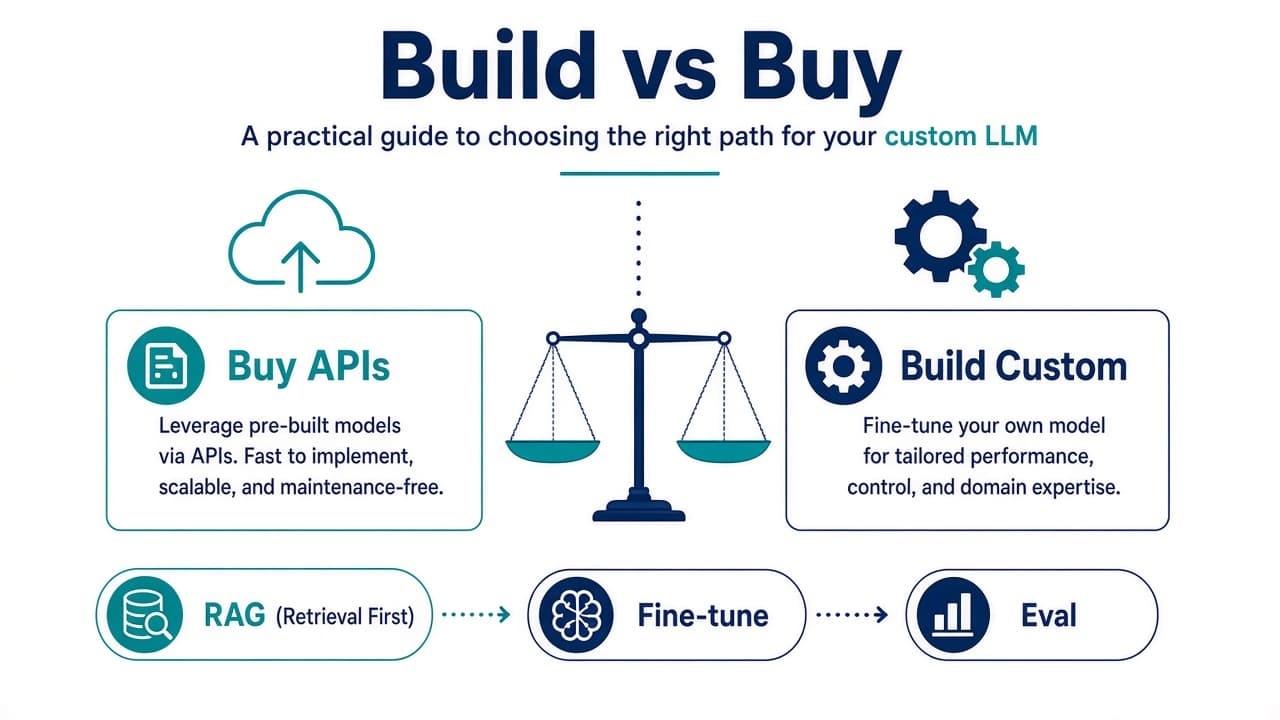
Custom LLM Development: When to Build vs Buy
A newspaper-style briefing on build vs buy for LLMs: when APIs win, when RAG is enough, when fine-tuning pays off, tools, options, and how Compile Vision scopes your AI roadmap.
11 min read
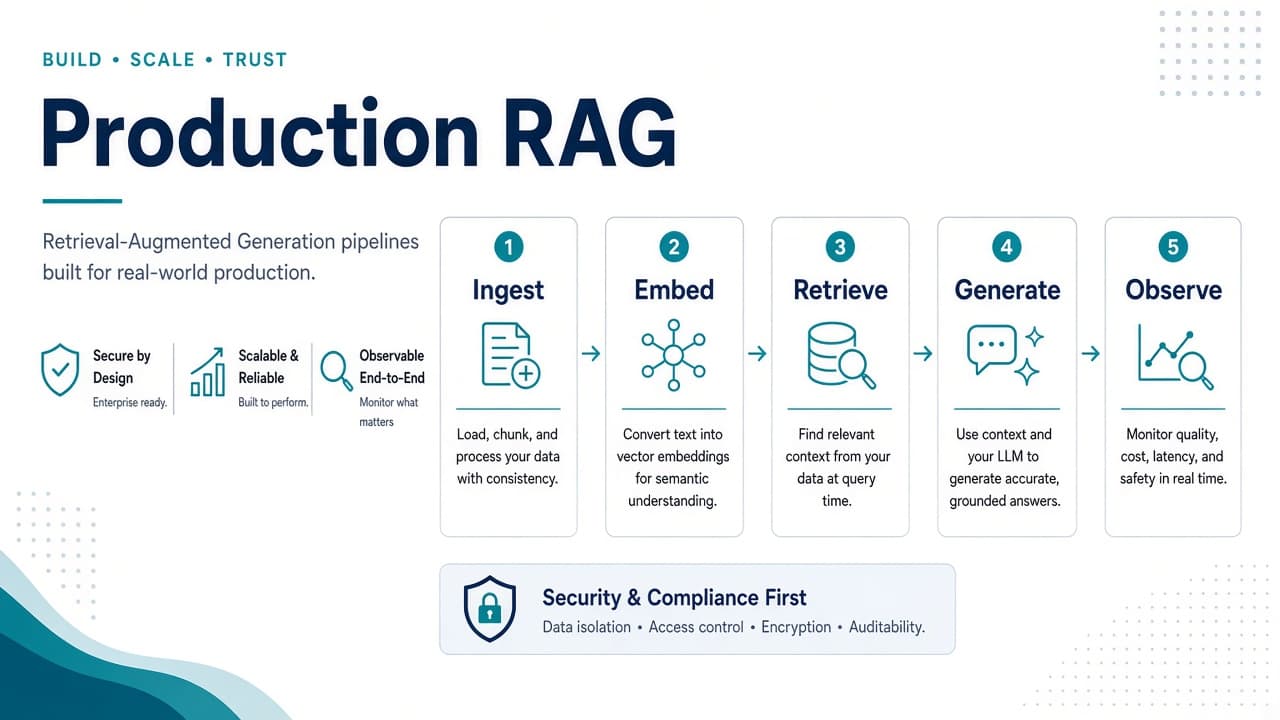
Building Production RAG Pipelines for Enterprise Search
A production briefing on enterprise RAG: service boundaries, security, hybrid retrieval, tooling, failure modes, and how Compile Vision ships document QA your teams can trust.